
Remote IX Peering
13 exchanges. One provider.
Internet exchange points are where traffic costs drop and performance improves. AgileSP's Remote IX service gives you a virtual port at any — or all — of our IXP memberships, handed off via a single BGP session from your existing infrastructure. No travel. No new colo. No individual membership fees per exchange.
What is Remote IX?
Peer everywhere. Connect once.
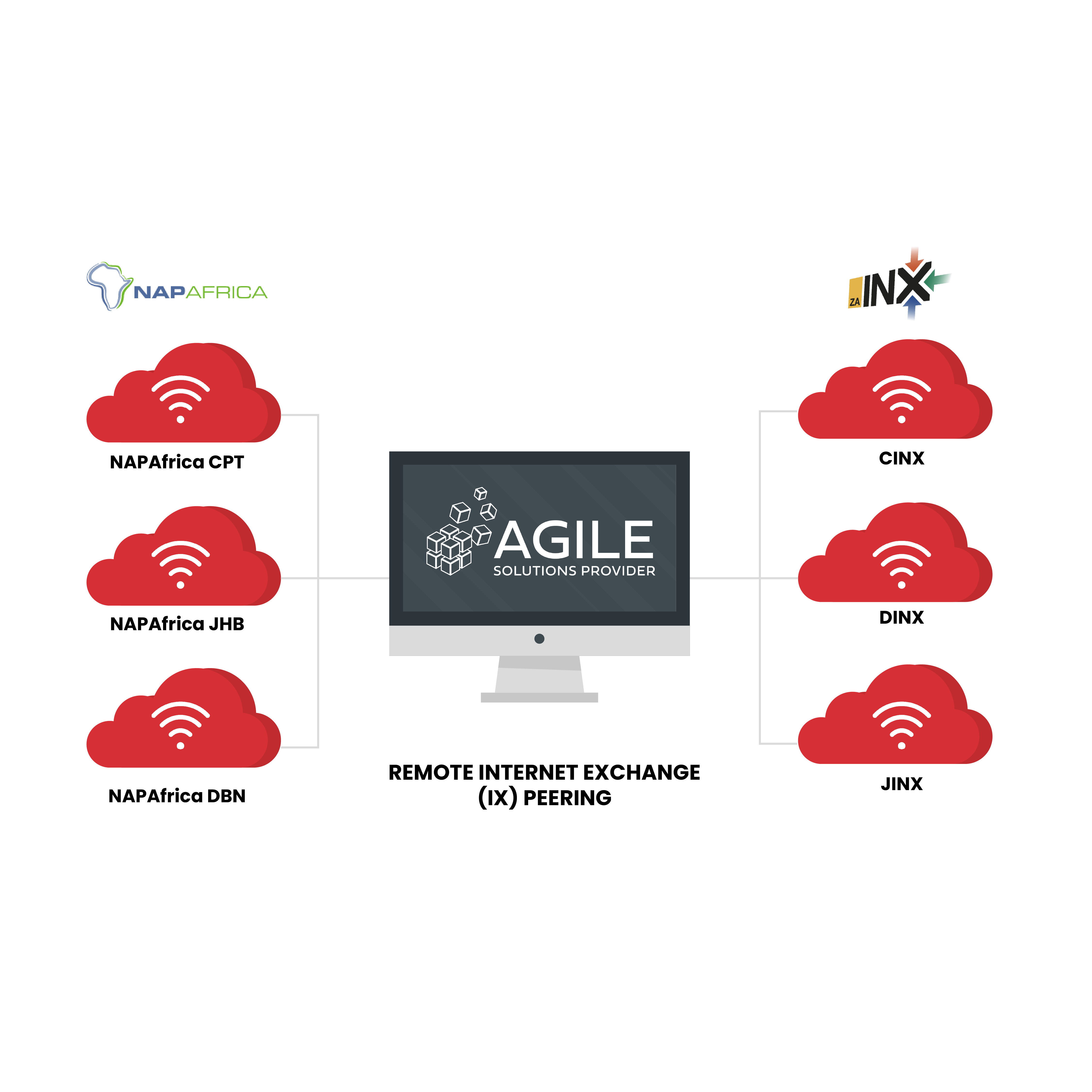
Remote IX (also called remote peering) allows an ISP, content provider, or network operator to participate in an internet exchange point without being physically present at that exchange's data centre. Instead, the customer connects to AgileSP's network (AS328748), and AgileSP provides the exchange port on their behalf.
The result: your ASN appears on the exchange, your BGP sessions are established directly with peers, and you receive the latency and cost benefits of IXP peering — without the need to purchase colocation space, order local cross-connects, or manage a separate exchange membership.
Exchange Portfolio
Access the full AgileSP IXP footprint.
South Africa
- NAPAfrica — Johannesburg, Cape Town, and Durban
- JINX (Johannesburg Internet Exchange)
- CINX (Cape Town Internet Exchange)
- DINX (Durban Internet Exchange)
- Speed-IX
Europe
- AMS-IX (Amsterdam Internet Exchange)
- LINX LON1 (London Internet Exchange)
- LONAP (London Access Point)
- NL-ix (Netherlands Internet Exchange)
- Frys-IX
This is one of the broadest IXP footprints of any African ISP, and it is available to Remote IX customers as a managed service.
How it works
Simple setup, direct peering paths.
You establish a BGP session with AgileSP. We announce the route server prefixes from your chosen exchanges directly to your session. Your traffic to those exchange members routes directly — not through AgileSP's transit network — giving you the low-latency, low-cost peering paths that IXPs are designed to provide.
Why IXP peering matters
Lower latency. Lower costs. Better resilience.
When two networks exchange traffic directly at an IXP, rather than routing it through a transit provider, several things happen simultaneously: latency drops because traffic takes a shorter path, costs fall because transit fees for that traffic are eliminated, and reliability improves because the path between the two networks is no longer dependent on a third party.
For South African ISPs and WISPs, the practical impact is significant. A large proportion of internet traffic consumed by South African users originates from content providers who are present at NAPAfrica, JINX, CINX, and DINX. Peering directly with those content providers — even remotely, via AgileSP's infrastructure — means lower latency for your customers and lower transit costs for your business.
European peering
Go beyond domestic exchanges.
Many African ISPs focus exclusively on domestic IXP access. AgileSP's Remote IX service goes further, giving customers access to AMS-IX in Amsterdam and LINX in London — two of the world's largest and most peered internet exchanges.
Through AgileSP's European PoPs, a South African ISP can peer directly with major global content networks that are present in Amsterdam or London but not in South Africa, reducing their dependence on paid transit for European-origin traffic and improving content delivery speeds for their end users.
Features
Remote IX features.
Virtual IXP port
Your ASN on the exchange, managed through AgileSP's infrastructure.
Direct BGP sessions
Peer directly with exchange participants, no AgileSP ASN in the path.
Flexible capacity
IXP port sizes scaled to your peering traffic volumes.
Multi-exchange access
One connection to AgileSP, access to multiple exchanges across South Africa and Europe.
NOC-assisted setup
AgileSP's team handles the technical exchange membership and configuration.
Route server access
Participate in exchange route server peering for immediate peer connectivity at setup.
Who is it for?
Remote IX for every network.
ISPs and WISPs
Access to South Africa's IXPs without colocation at every exchange location.
Content providers
Reach South African and African users with lower latency by peering at African exchanges.
International networks
Land traffic in South Africa via a single exchange relationship.
Cloud and hosting providers
Reduce transit costs by peering directly with high-traffic consumer networks at local IXPs.
FAQ
Frequently asked questions.
- What is Remote IX?
- Remote IX allows you to peer at internet exchanges where AgileSP is physically present, without needing to colocate at that exchange yourself. AgileSP acts as the transport layer — your BGP session is with AgileSP, and we relay the IXP peering sessions to you.
- Which IXPs can I access via Remote IX?
- All 13 exchanges where AgileSP holds active memberships are available. Access to specific exchanges can be enabled individually — you do not need to activate all 13 at once.
- How is traffic handed off?
- Traffic is handed off via a BGP session between your router and AgileSP's infrastructure at your mutual interconnection point. The exchange-learned routes are exported to your session, and your traffic to those exchange prefixes takes the direct IXP path.
- Is Remote IX a replacement for IP transit?
- No — Remote IX complements IP transit, it does not replace it. Exchange peering covers traffic to networks that are present at those exchanges. For everything else, you still need transit. Most customers take both services.
- What is the minimum port size?
- Port sizes start at 1G. Contact our team for options based on your expected traffic volume and which exchanges you want to activate.